
What will you be able to do?
From outcomes to observable evidence
case-flood-2011 · v1.0.0Intended outcomes
Knowledge
Distinguish facts and evidence limits in this case.
Skills
Create a dependency map and damage–loss–needs table for a fictional area, with recovery priorities and verification questions.
Ethics
Explain effects on recipients and people who may be excluded.
Character
Revise reasoning when new evidence or personal limits emerge.
Practise through an activity
Create a dependency map and damage–loss–needs table for a fictional area, with recovery priorities and verification questions.
Collect evidence for assessment
- Knowledge
A source-linked evidence-scope note.
case-flood-2011-K- Skills
The proposed artifact, with assumptions and owners.
case-flood-2011-S- Ethics
Choice rationale and an inclusion check.
case-flood-2011-E- Character
Before/after reflection and improvement actions.
case-flood-2011-C
Project learning synthesis showing proposed outcomes, activity and evidence. This is not a university-endorsed assessment framework.
Module references:[flood-2011][natech-2024][ddpm-shelter][who-simex-2017][chs-2024][ocha-data][who-aar-2019][aunqa-2020]
Suggested preparation: HADR foundations and people-centred assistance
Event and evidence
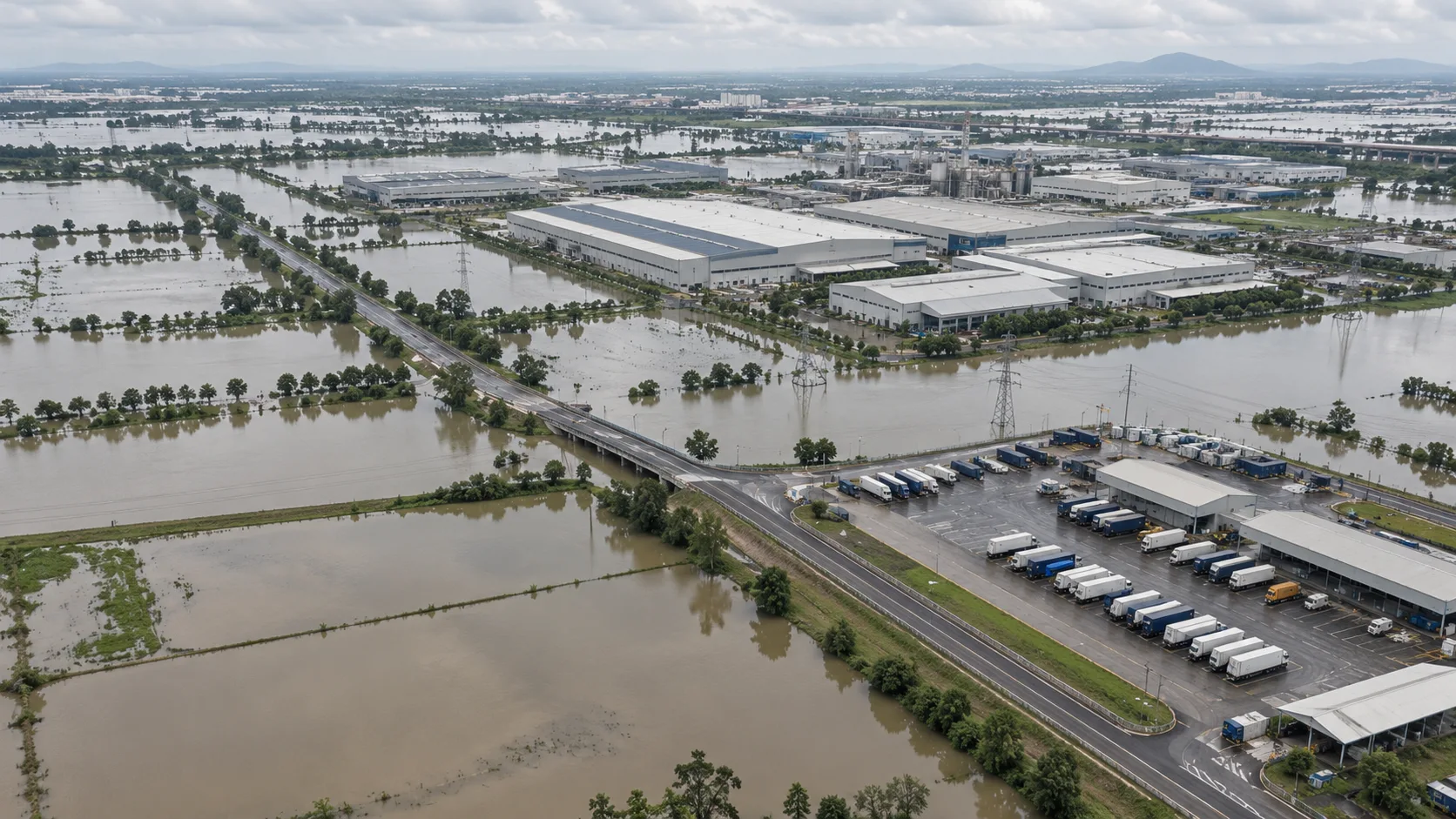
The Thai government, World Bank and partners assessed 26 of 66 affected provinces. The report distinguishes damage, losses and recovery needs across sectors including industry and essential services.
What the evidence supports
This is a rapid, time-specific assessment, not a survey of every affected area. Aggregate estimates do not establish outcomes for individual factories or communities.
Connect disciplines for analysis
Proposed analysis: map roads, water, power, workers, factories and shelters. Separate damaged assets from interrupted services, then identify who must coordinate recovery choices. Production disruption alone does not establish a Natech accident.
Apply in an exercise
Project-proposed activity: Create a dependency map and damage–loss–needs table for a fictional area, with recovery priorities and verification questions. Exercise data are fictional and must be separated from historical facts.
See the process at a glance
A synthesized learning diagram. Read it alongside the lesson and original sources.
Set the scope
Record time, geography, evidence type and unresolved claims.
Connect information and roles
Map actors and information handovers in the fictional task.
Create evidence
Develop a plan with assumptions, owners and rationale.
Review and revise
Record what changed, the evidence behind it and an improvement owner.
Explore a decision
Fictional scenario: one road serves a shelter and a factory employing local residents. Repair resources are limited. How should planning begin?
Learning rationale: consider life, services and livelihoods together, with inspectable reasoning before selecting recovery priorities.
From knowledge to evidence
Create a dependency map and damage–loss–needs table for a fictional area, with recovery priorities and verification questions.
| Criterion | Proficient | Developing |
|---|---|---|
| Evidence and scope | Separates facts, assumptions and limits with sources. | Combines times or areas without limits. |
| Coordination and artifact | Artifact addresses the task with owners and verification points. | Lists actions without coordination or missing information. |
| Access and dignity | Checks exclusion and explains mitigation. | Primarily prioritizes team convenience. |
| Improvement | Shows how evidence changed a decision. | Declares success without checking assumptions. |
A proposed rubric for educators to adapt, not a university accreditation standard.
Check your understanding
Answer all 5 questions, then review the explanations. This score is for self-study.
References & further verification
- Thai Flood 2011: Rapid Assessment for Resilient Recovery and Reconstruction Planning ↗Royal Thai Government / World Bank and partners · 2012
Report 69822 v2; foreword p.i, executive summary pp.1–4; local PDF extraction pp.1–24 - Managing Risks from Natural Hazards to Hazardous Installations (Natech) ↗OECD / UNECE / JRC / UBA · 2024
Publisher abstract via search index; direct page 403; November 2024 - คู่มือการจัดตั้งและการบริหารจัดการศูนย์พักพิงชั่วคราว ↗DDPM / กรมป้องกันและบรรเทาสาธารณภัย · 2565 / 2022
ISBN 978-974-458-7367; PDF p.3 and pp.6–11; government-hosted copy - WHO Simulation Exercise Manual ↗World Health Organization · 1 February 2017; WHO/WHE/CPI/2017.10
Publication overview; manual glossary (exercise project, exercise report); exercise planning/conduct/evaluation - Core Humanitarian Standard ↗CHS Alliance / Groupe URD / Sphere · 2024
Publisher overview of commitments - Revised OCHA Data Responsibility Guidelines ↗OCHA Centre for Humanitarian Data · 2025
20 February 2025 announcement; scope paragraphs - Guidance for After Action Review (AAR) ↗World Health Organization · 1 April 2019; WHO/WHE/CPI/2019.4
Overview: purpose and four formats; accompanying AAR toolkits - Guide to AUN-QA Assessment at Programme Level, Version 4.0 ↗ASEAN University Network · October 2020
Sections 2.1–2.4, printed pp. 16–27: outcomes, curriculum, teaching and assessment
Cite this module
PK-Research. (2026). Thailand floods 2011: interconnected impacts and recovery (case-flood-2011, v1.0.0). HADR–CPX Knowledge Commons. https://hadr-cpx.pk-research.work/en/modules/case-flood-2011/