
What will you be able to do?
From outcomes to observable evidence
eoc-cop-decisions · v0.1.0Intended outcomes
Knowledge
Explain coordination versus decision authority and COP versus SITREP, identifying each source’s context.
Skills
Update a COP, produce a decision log and track tasks across three cards while preserving provenance, time, status and ownership.
Ethics
Justify allocation and publication considering people still waiting, uncertainty and necessary data.
Character
Demonstrate accountability when correcting errors, hearing dissent and handing over unfinished work.
Practise through an activity
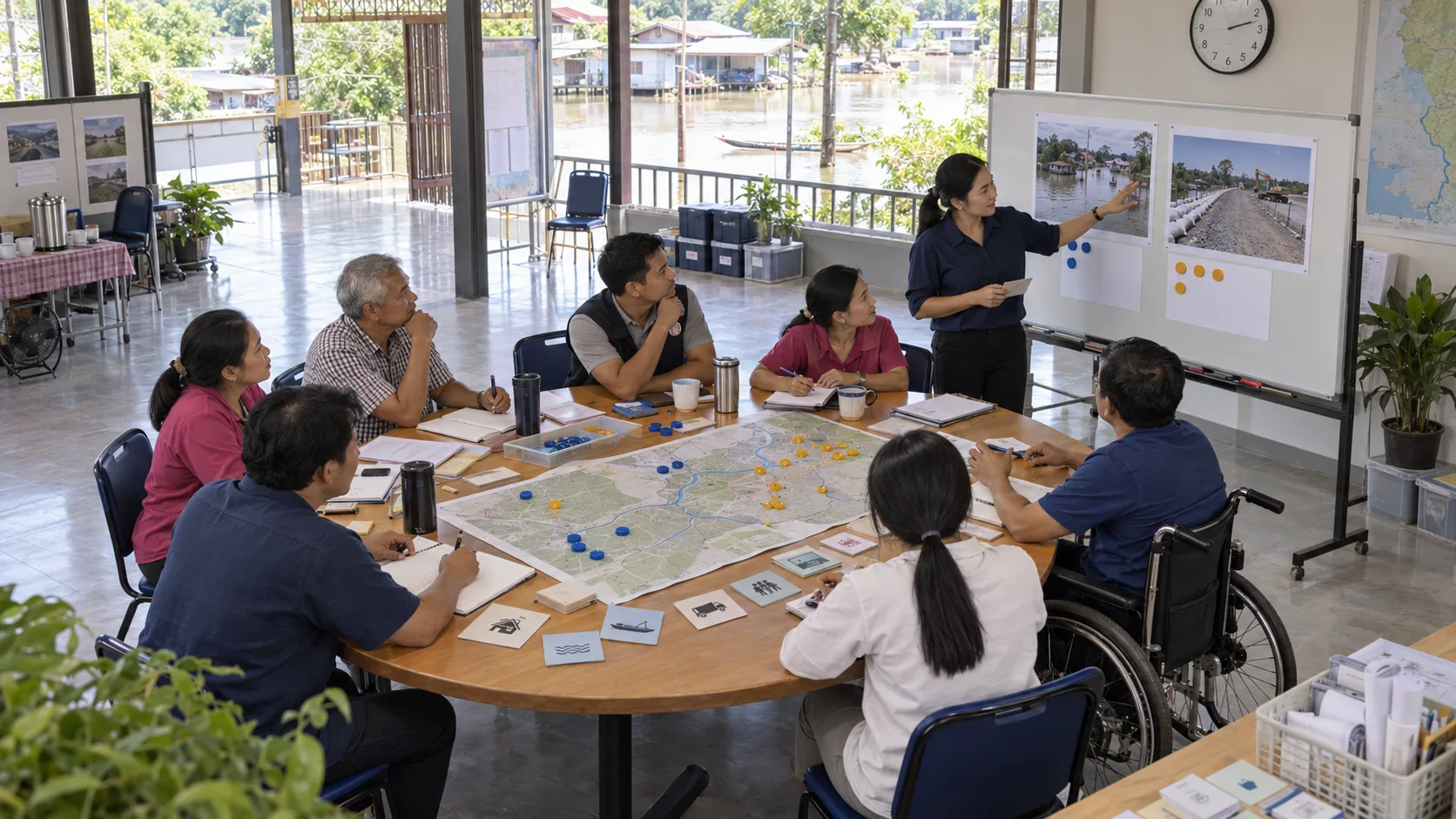
Original project CPX: groups of 4–6 rotate information, request coordination, option proposer, simulated approval, communication and observer roles. Smaller groups may combine roles and disclose limits. Submit the role/authority-check table, COP versions, 08:30 SITREP, decision/open-task log, simulated public brief, 09:00 handover read-back and one improvement. Mark every artifact ‘exercise only’; contact or task no real agency. Solo learners complete two rounds with role switching and self-checks, explicitly noting the absence of another person’s message-reception evidence or peer behaviour observations.
Collect evidence for assessment
- Knowledge
A sourced role table and information-flow diagram with limits, plus reasoned quiz responses.
EOC-K- Skills
COP versions, 08:30 SITREP, conflict/decision/open-task records and the 09:00 handover read-back.
EOC-S- Ethics
At least two options with affected groups, plus a simulated public message that does not overstate results.
EOC-E- Character
Behaviour observations during correction and handover, with revision reasons, task ownership and a plan for repeated observation; no lasting-character inference from one session.
EOC-C
Project learning synthesis showing proposed outcomes, activity and evidence. This is not a university-endorsed assessment framework.
Module references:[ddpm-plan][eoc-fema-toolkit][eoc-fema-ics-2023][eoc-undac-decisions-2024][ocha-undac-situation-2024][ifrc-icrc-assessment-2008][who-simex-2017][who-aar-2019][aunqa-2020]
Suggested preparation: HADR foundations and people-centred assistance HADR coordination in Thailand Assessing needs and writing a situation note
Coordination and decision authority in Thailand
Public-review lesson as of 15 October 2026: a learning proposal without documented expert endorsement or programme accreditation. Every CPX location, role, time, quantity and message is fictional. Use no personal data from real incidents. This is not an operational order.
The DDPM 2021–2027 plan maps national and territorial mechanisms, including separate Bangkok arrangements, in Figure 3-2 on p.43. Page 124 distinguishes situation information, proposed options, coordination with assigned agencies and progress monitoring in support of incident management.
Original exercise: distinguish information producer, option proposer, decision owner, task recipient and publication approver in a role table. Record unresolved authority as ‘applicable law/plan/local or incident order to be checked’; do not invent a document. An EOC label or coordination role does not establish that learners can command every field agency. Real use requires responsible personnel to verify applicable authority and delegation.
Fictional baseline, one exercise day in Thailand time, 08:00: shelter EX-A needs 60 household kits and EX-B needs 40, both verified. Warehouse EX-W holds 80 kits, with none dispatched initially. A’s route is verified under exercise assumptions; B’s is pending. Submit an allocation proposal by 08:30 and hand over at 09:00. The exercise specifies neither people per kit nor safety of any real route.
Organize EOC functions and activation boundaries
FEMA describes EOCs as designed around each jurisdiction’s needs, with guidance covering establishment through deactivation. This is US context; it does not establish universal activation levels or Thai thresholds.
Project tabletop proposal: allocate monitoring/analysis, request coordination, resource tracking, decision recording and communication separately from approval. One person may cover several functions, but identify conflicts or absent checks. Simulate activation, scaling or deactivation as a proposal to the responsible role with reasons, staffing needs, fallback communication and outstanding work. No colour or numerical level is prescribed as a standard.
Before the first card, the controller states that the team can propose and record; a simulated approval role confirms allocations and publication. Simulated agency representatives acknowledge their own tasks. Review at 08:15, 08:30 and 09:00 as classroom conditions, not government reporting intervals. If the main channel fails, use time-stamped paper records with an author, then reconcile when it returns.
Connect information needs, SITREP and the COP
UNDAC p.139 connects collection to the decision owner, decision and timing. FEMA p.105 describes a COP as an updated incident overview and EEI as important information for decisions; p.110 describes an ICS SITREP as an operational-period summary. Use these concepts for comparison, without treating US positions or forms as Thai requirements.
Original exercise: ask, ‘Before 08:30, what can we propose sending where, and what remains constrained?’ Define minimum information: need and units, available stock, route constraints, verifier, timestamp and conditions that change the decision. Do not collect every field merely because a form has it. The question owner must explain which option the answer changes.
Create one paper or digital COP: an annotated fictional location map, needs/resources table, uncertainties and decisions/outstanding tasks. EX-A, EX-B and EX-W are exercise codes, not official codes. Separate observation, receipt and last-update times. Use ‘verified/reported pending check/unknown’ with reasons, without unsupported numerical confidence.
At reporting time, freeze an 08:30 SITREP with its data cut-off, changes, limits, decisions and requested decisions. The COP may evolve while previous versions remain available. Information arriving at 08:35 must not silently rewrite the 08:30 report; issue a revision or follow-up record. This is a project exercise agreement, not an official template.
Preserve conflicts and decide under uncertainty
ICRC/IFRC §8.1, pp.67–68 recommends comparing diverse sources, examining discrepancies and documenting assumptions and follow-up when conflicts remain. Use this to check reasoning, without treating the 2008 manual’s source counts or timelines as current mandatory thresholds.
Fictional inject 1, 08:10: a forwarded message says ‘B needs 70 kits’ without survey time or household scope; the verified 08:00 record says 40. By 08:15, log the conflict linking both reports, ask B’s liaison about time, units and duplication, and assign follow-up ownership and a response time. Do not sum to 110 or silently replace 40 with 70.
Separate hypotheses from facts: duplication, new coverage or changed need are possibilities, not conclusions. Propose work that does not require resolving B’s figure, such as warehouse preparation, while preserving approval and dispatch conditions. ‘Pending verification’ is not a reason to stop all work or evade the decision deadline.
Compare options and keep a reviewable decision log
DDPM p.124 item 5.1 links situation information with decision options and recommendations. UNDAC p.180 emphasizes reasoning, evidence and reporting limitations. This exercise turns those concepts into an original decision log, not an agency-approved prioritization formula.
Fictional inject 2, 08:20: B’s liaison confirms that 70 included 30 duplicate entries, so need remains 40 kits. The route representative confirms B’s main road closed and no alternative verified. Stock remains 80. A60+B40 totals 100, a stock shortfall of at least 20 at this time. By 08:30, submit a proposal distinguishing insufficient stock from B’s access constraint.
Compare at least two options, such as proposing A60 with B20 held conditionally, or A40/B40 conditionally. State who waits, expected benefits, disadvantages, gaps and what is feasible in the exercise period. Do not claim A has greater need merely because access is easier. If relative urgency is unknown, disclose and seek verification. Do not propose using the closed road. No allocation is always uniquely fair.
Project decision record: ID/time, question, options, evidence/uncertainty, proposal, reasons, simulated decision owner, preconditions, action owner, review time and dissent. Where authority or resources are missing, escalate to the designated exercise role with the required decision and deadline. Escalation does not equal automatic approval.
Task, track resources and escalate unresolved needs
DDPM p.124 item 5.2 addresses coordination with assigned agencies and progress monitoring. This exercise therefore separates requested, approved and completed states with distinct evidence, so decisions remain traceable after the meeting.
To give every group the same handover state, the controller supplies a fixed 08:35 event: simulated approval selects A60 and conditionally holds B20 pending a verified route. The warehouse dispatches A60 and the transporter acknowledges. Record 60 in transit and 20 still in the warehouse, conditionally reserved. Do not mark B20 dispatched. Preserve the original proposals and discuss differences from the simulated decision.
Each original task card records decision ID, requested action, units/quantity, owner, response deadline, constraints, acknowledgement and completion evidence. If overdue or newly constrained, log why and escalate with a proposal. Do not count promised incoming goods as available, or close a request merely because a message was sent. Continue to HADR logistics and resource allocation (logistics-resources) for detailed reconciliation.
Hand over and communicate responsibly
UNDAC p.134 addresses handing information processes to others who can maintain them; p.137 covers responsibility for personal and non-personal data; p.180 emphasizes reporting for its audience. Information useful for internal coordination therefore requires review before public release.
Fictional inject 3, 08:45: A confirms receipt of all 60 kits, but household distribution is unreported. B has received none; 20 remain in the warehouse and no alternative route is verified. A rumour says ‘all locations fully supplied’. By 09:00, update the COP, handover note and simulated correction. Do not turn ‘A received 60’ into ‘60 households served’, or claim B has received supplies.
Handover state: 80 = 60 received at A + 20 in warehouse; none in transit at 08:45. B’s 40 remain undelivered: 20 reserved and 20 without stock cover. The stock deficit of 20 differs from B’s undelivered need of 40. The incoming shift reads back confirmed facts, unknowns, route/additional-stock owners and the next review time. Log fictional outgoing/incoming roles and acknowledgement time.
Draft simulated public message: ‘As of 08:45, A has received 60 kits; household distribution is being checked. B has received none. Route and additional-resource follow-up continues. Next update 09:15.’ Submit for simulated approval and select accessible channels. Include no affected-person data or unnecessary sensitive detail. 09:15 is an exercise commitment owned by the incoming shift, not a real public promise. Continue to Digital technology and innovation for HADR (digital-innovation) for versioning and fallback channels.
Use CPX evidence to improve practice
WHO describes simulation exercises as opportunities to practise roles and identify preparedness gaps; its AAR guidance supports review and continuing learning. Here these ideas inform a classroom HADR CPX, not an official WHO capability assessment or a complete AAR.
The project’s OBE design connects outcomes to artifacts and criteria, rather than dashboard appearance alone. AUN-QA alignment guidance supplies educational context, not lesson accreditation. KSEC is the project’s framework: K explains roles/information; S produces the COP/decision record; E reasons about people waiting and publication; C observes accountability when challenged and handing over.
After the exercise, compare intentions, what happened at the table, supporting evidence and changes using timestamps and versions. Choose one improvement with owner, deadline and retest, such as an incoming shift explaining B40 without help. Observe C at least during the correction after card 2 and handover after card 3, then gather observations across further occasions. Neither a quiz nor one exercise establishes lasting character.
See the process at a glance
A synthesized learning diagram. Read it alongside the lesson and original sources.
Read context and boundaries · 15 minutes
Read the cited passages, distinguish authority/coordination, then map fictional roles and unresolved checks.
Set questions and baseline · 15 minutes
Use the 08:00 facts to define decision questions and minimum fields, then create the COP and task register.
Respond to three cards · 30 minutes
Simulate 08:10, 08:20 and 08:45; the controller also supplies the fixed 08:35 event. Retain revisions and at least two options.
Hand over and check understanding · 15 minutes
The incoming shift reads back status/open tasks, checks the simulated public brief, then completes five reasoned quiz responses.
Review and plan a retest · 15 minutes
Use artifacts against the KSEC rubric; name one improvement, owner, deadline and next check. Classroom duration differs from scenario time.
Explore a decision
Fictional post-card-3 situation at 08:45: A received 60 kits; B received none; 20 remain in warehouse; B’s main road is closed and no alternative is verified. A rumour says everything was delivered. You must hand over at 09:00. What is best?
Records show achievements and unfinished work: A received 60 but distribution is unknown; B awaits 40, with 20 reserved and 20 lacking stock. Read-back and review times establish ownership. There is no basis to overstate success or dispatch through an unverified route.
From knowledge to evidence
Original project CPX: groups of 4–6 rotate information, request coordination, option proposer, simulated approval, communication and observer roles. Smaller groups may combine roles and disclose limits. Submit the role/authority-check table, COP versions, 08:30 SITREP, decision/open-task log, simulated public brief, 09:00 handover read-back and one improvement. Mark every artifact ‘exercise only’; contact or task no real agency. Solo learners complete two rounds with role switching and self-checks, explicitly noting the absence of another person’s message-reception evidence or peer behaviour observations.
| Criterion | Proficient | Developing |
|---|---|---|
| K · Distinguish roles and information products | Explains authority checks and Thai/international scope; distinguishes evolving COP from time-bound SITREP with relevant citations. | Uses EOC as a claim of universal authority or cannot distinguish COP/SITREP and lacks sources. |
| S · Turn information into traceable decisions and tasks | Preserves B40/B70 until evidence resolves them, retains versions/times/provenance, compares two options and owns tasks; correctly hands over B40 undelivered versus stock deficit20. | Double-counts, erases revisions, confuses reservation with receipt or hands over without owner/follow-up time. |
| E · Account for people waiting and publication | Identifies who waits under each option, does not equate easy access with greater need, and communicates only supported claims through the review role. | Omits those waiting, claims fairness without comparison or publishes overstated success/unnecessary data. |
| C · Listen, correct and sustain accountability | Observations at correction and handover show listening, disclosed revision reasons and ownership of open work, with further observation planned across occasions. | Only self-claims or quiz scores, without behaviour/artifacts across stages, or no owner for unfinished work. |
A proposed rubric for educators to adapt, not a university accreditation standard.
Check your understanding
Answer all 5 questions, then review the explanations. This score is for self-study.
References & further verification
- แผนการป้องกันและบรรเทาสาธารณภัยแห่งชาติ พ.ศ. 2564–2570 ↗กรมป้องกันและบรรเทาสาธารณภัย (DDPM) · พ.ศ. 2564–2570 (2021–2027)
Printed p. 43, Figure 3-2 (PDF p. 54); printed p. 124, incident-management support, items 5.1–5.5 (PDF p. 135); official catalog dpm-gd007 - Emergency Operations Center (EOC) Toolkit ↗FEMA, Preparedness Toolkit · Undated webpage; accessed 2026
Opening paragraphs; EOC How-to Quick Reference Guide overview - Incident Command System (ICS) Training Reference Guide ↗FEMA / Emergency Management Institute · March 2023
Printed p. 105 (PDF p. 117), Common Operating Picture and Essential Elements of Information; printed p. 110 (PDF p. 122), Situation Reports - UNDAC Handbook, 8th Edition, Version 2 — Section F: information needs and handover ↗United Nations OCHA · June 2024, Version 2
Printed p. 134 (section PDF p. 7), F.1.1.2 During deployment, Handover procedures; printed p. 139 (section PDF p. 12), F.2.1.1 Know what you need to know - UNDAC Handbook, 8th Edition, Version 2 — Section F: Situation ↗United Nations OCHA · June 2024, Version 2
Printed p. 137 (section PDF p. 10), F.1.3 Data responsibility and security; printed pp. 180–181 (section PDF pp. 53–54), F.3.1 Reporting - Guidelines for assessment in emergencies ↗ICRC / IFRC · March 2008
Printed pp. 12, 17, 29–31, 67–68 (PDF pp. 14, 19, 31–33, 69–70): §§2.2, 3, 5.3.4–5.3.6 and 8.1 - WHO Simulation Exercise Manual ↗World Health Organization · 1 February 2017; WHO/WHE/CPI/2017.10
Publication overview; manual glossary (exercise project, exercise report); exercise planning/conduct/evaluation - Guidance for After Action Review (AAR) ↗World Health Organization · 1 April 2019; WHO/WHE/CPI/2019.4
Overview: purpose and four formats; accompanying AAR toolkits - Guide to AUN-QA Assessment at Programme Level, Version 4.0 ↗ASEAN University Network · October 2020
Sections 2.1–2.4, printed pp. 16–27: outcomes, curriculum, teaching and assessment
Cite this module
PK-Research. (2026). EOC, common operating picture and crisis decisions (eoc-cop-decisions, v0.1.0). HADR–CPX Knowledge Commons. https://hadr-cpx.pk-research.work/en/modules/eoc-cop-decisions/
Research for further inquiry
Topic-related briefs for critical reading, not validation of every claim in the lesson.
- Institutional capacity, organizational performance and multi-stakeholder collaboration in local disaster risk reduction: evidence from West Sumatra, Indonesia (2026)
- Inter-agency collaboration in building urban fire resilience in Indonesia: how do metropolitan cities address it? (2025)
- Developing a concept of a context-aware common operational picture (2017)
- Disaster governance and the scalar politics of incomplete decentralization: Fragmented and contested responses to the 2011 floods in Central Thailand (2016)