
What will you be able to do?
From outcomes to observable evidence
business-area-continuity · v0.1.0Intended outcomes
Knowledge
Distinguish continuity management from a plan document and explain area coordination.
Skills
Trace disruption through dependencies and develop follow-up options.
Ethics
Justify priorities considering workers and communities.
Character
Coordinate assumptions and revise the plan collaboratively after an exercise.
Practise through an activity
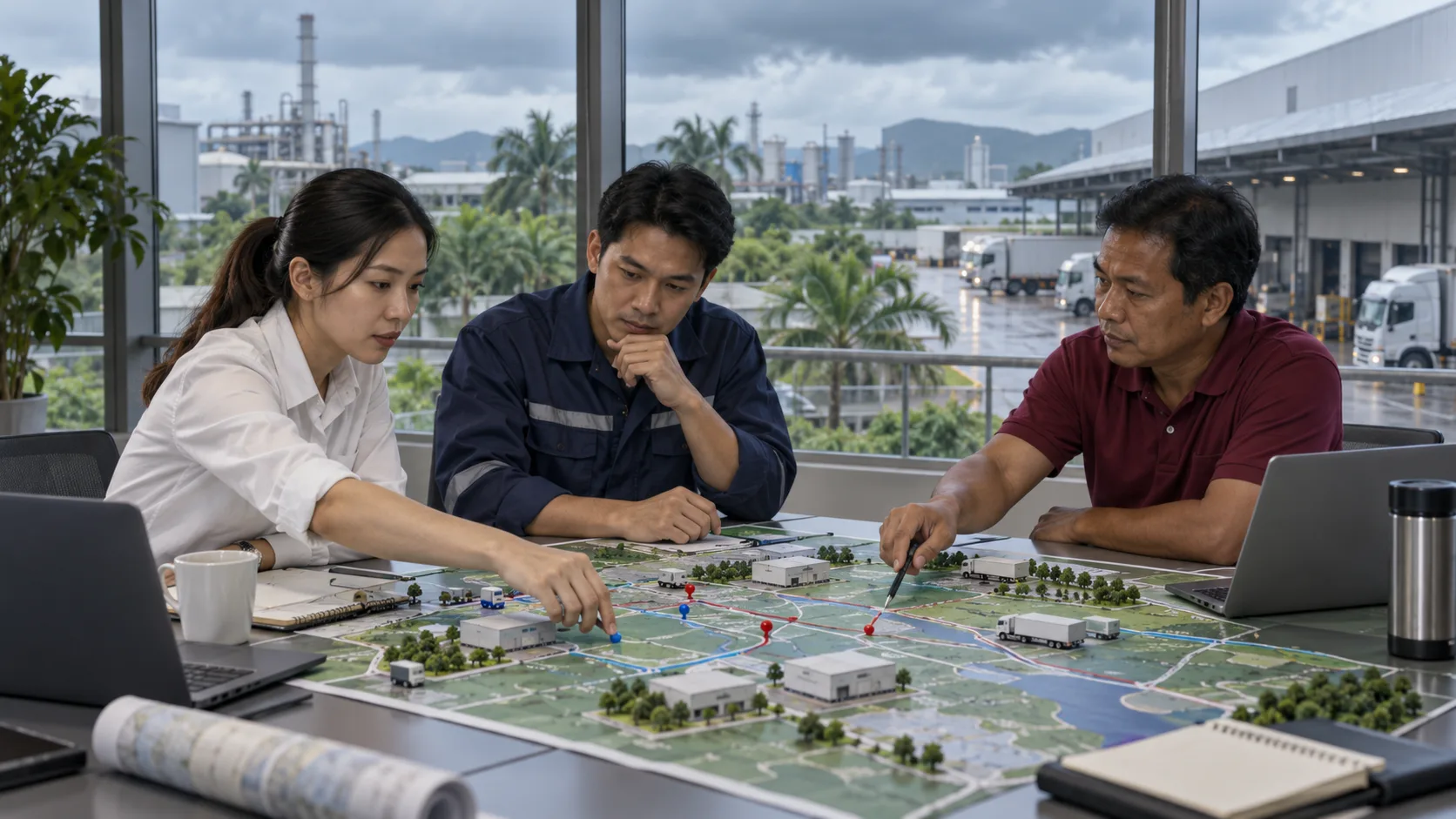
Original project activity: assign factory, clinic, community and information-coordinator roles. Map dependencies and impacts from the scenario. Propose two options without inventing restoration times. Then introduce an unavailable alternate route. Submit a revision with verification owners and peer feedback. Assess KSEC through work products and behaviour; the five-question quiz does not replace operational testing or certify a BCP.
Collect evidence for assessment
- Knowledge
A concept map and explained quiz responses.
AREA-K- Skills
A dependency map and options record with task owners.
AREA-S- Ethics
An impact table reflecting stakeholder perspectives.
AREA-E- Character
A change record, assigned owners and team feedback.
AREA-C
Project learning synthesis showing proposed outcomes, activity and evidence. This is not a university-endorsed assessment framework.
Module references:[adpc-area-bcp-2017][ddpm-plan]
Suggested preparation: HADR foundations and people-centred assistance Thailand floods 2011: interconnected impacts and recovery
Read Bangkadi as a historical case
The 2017 report concerns Area BCP around Bangkadi Industrial Park, Pathumthani. Its cover credits ADPC facilitation for NESDB with JICA support. It does not establish current system conditions. This lesson’s new scenario is not a reconstruction. Read the 2011 flood case alongside it, separating historical facts from questions that need checking in a present-day area.
A plan sits within management
Printed pp. 16–21 distinguish BCM as management from BCP as a plan document, linking Area BCM to stakeholder cooperation. Exercise: name who maintains the plan, supplies information and reviews changes. Possessing a document alone does not answer those questions. This lesson does not assess ISO conformity or adopt the report’s historical standard edition as a current requirement.
Trace dependencies beyond an organisation
Printed pp. 17–19 and 96–97 connect disruption to resources, transport and utilities, including bottlenecks affecting recovery. Original exercise: start with one service, such as delivery, and draw links to workers, roads, power and information. Identify an information owner for each link. If restoration time is unconfirmed, mark it unknown and assign verification instead of inventing certainty.
Use an exercise to identify improvements
Printed pp. 158–161 discuss review, exercises and tabletop limitations. Our exercise adds a report that the alternate route is unavailable. Revise options and identify conditions requiring confirmation before resumption. Submit a change record and a follow-up review with assigned owners. Discussion can reveal gaps; it does not demonstrate equipment performance, system capability or achievable restoration time.
See the process at a glance
A synthesized learning diagram. Read it alongside the lesson and original sources.
Set scope
Choose one fictional service and its internal and external stakeholders.
Trace impacts
Map dependencies, identify bottlenecks and separate facts from assumptions.
Discuss options
Compare effects on businesses, workers and communities, assigning task owners.
Exercise and revise
Receive one changed fact, submit a revision and identify what needs further testing.
Explore a decision
Original fictional scenario: two factories and a community clinic share a road. Factory A has backup power, but the road is closed. Factory B proposes an unchecked minor road. Providers have not confirmed restoration times. What should the team propose?
Option C addresses shared dependencies and missing information. Backup power does not resolve road access. The exercise identifies verification and decision roles without certifying a real route.
From knowledge to evidence
Original project activity: assign factory, clinic, community and information-coordinator roles. Map dependencies and impacts from the scenario. Propose two options without inventing restoration times. Then introduce an unavailable alternate route. Submit a revision with verification owners and peer feedback. Assess KSEC through work products and behaviour; the five-question quiz does not replace operational testing or certify a BCP.
| Criterion | Proficient | Developing |
|---|---|---|
| K · Conceptual scope | Distinguishes process from document and explains the area perspective. | Uses BCM/BCP interchangeably without explanation. |
| S · Dependencies | Links services to external resources and assigns verification owners. | Lists resources without tracing impacts. |
| E · Stakeholder effects | Hears every role and explains trade-offs between two options. | Prioritises only one party’s benefit. |
| C · Collaborative learning | Owns tasks and revises collaboratively, stating remaining limits. | Ignores new information or leaves follow-up unowned. |
A proposed rubric for educators to adapt, not a university accreditation standard.
Check your understanding
Answer all 5 questions, then review the explanations. This score is for self-study.
References & further verification
- Natural Disaster Risk Assessment and Area Business Continuity Plan Formulation: Bangkadi Industrial Park Area, Pathumthani Province, Thailand ↗ADPC-facilitated report for NESDB, supported by JICA (Thailand Office) · February 2017 final report
Cover PDF p.1; printed pp.16–21, 96–97, 158–161 (PDF pp.28–33, 108–109, 170–173); 221-page file; selected sections inspected - แผนการป้องกันและบรรเทาสาธารณภัยแห่งชาติ พ.ศ. 2564–2570 ↗กรมป้องกันและบรรเทาสาธารณภัย (DDPM) · พ.ศ. 2564–2570 (2021–2027)
Printed p. 43, Figure 3-2 (PDF p. 54); printed p. 124, incident-management support, items 5.1–5.5 (PDF p. 135); official catalog dpm-gd007
Cite this module
PK-Research. (2026). Business and service continuity across an area (business-area-continuity, v0.1.0). HADR–CPX Knowledge Commons. https://hadr-cpx.pk-research.work/en/modules/business-area-continuity/