
What will you be able to do?
From outcomes to observable evidence
community-shelter · v0.1.0Intended outcomes
Knowledge
Explain why hazards, access and services must be considered together.
Skills
Compare two sites and assign verification tasks before recommending one.
Ethics
Propose ways to reduce access barriers with input from affected people.
Character
Own an assigned role and revise a proposal when information changes.
Practise through an activity
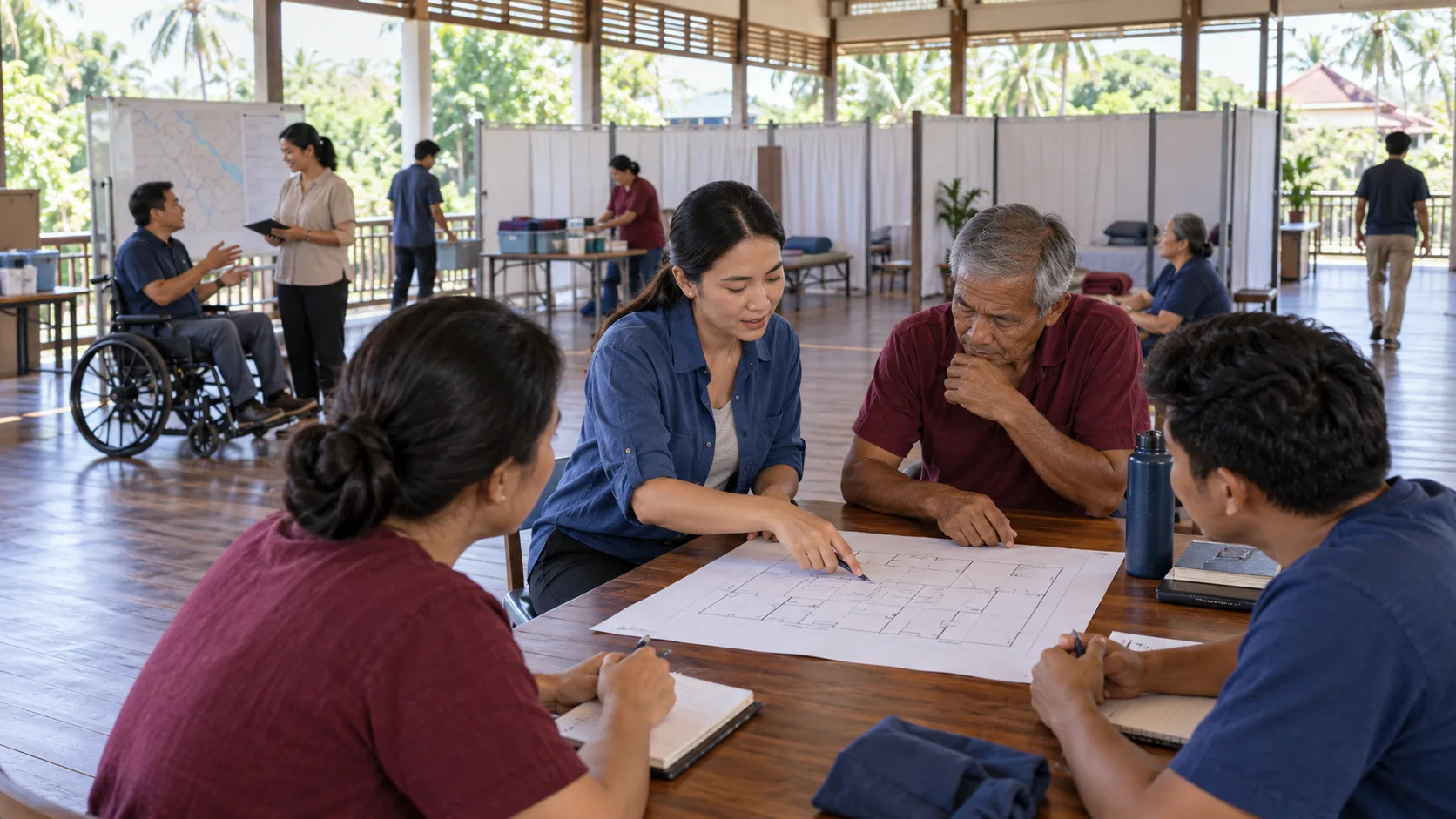
Original project activity: use three roles—resident representative, information collector and coordinator. Using sites A/B, create a comparison and one-page proposal. Add language and mobility concerns. The facilitator then reports that route B is unavailable. Revise the proposal and identify remaining checks. Submit both versions and peer feedback. Use the KSEC rubric below; the five-question quiz supports understanding and does not establish practical competence or accreditation.
Collect evidence for assessment
- Knowledge
A rationale with page references and explained quiz responses.
SHELTER-K- Skills
A comparison table and follow-up ownership record.
SHELTER-S- Ethics
A proposal responding to resident concerns with an equity rationale.
SHELTER-E- Character
Before-and-after decision notes with peer observations.
SHELTER-C
Project learning synthesis showing proposed outcomes, activity and evidence. This is not a university-endorsed assessment framework.
Module references:[adpc-shelter-2017][ddpm-shelter][ddpm-shelter-catalog][ddpm-plan]
Suggested preparation: HADR foundations and people-centred assistance Thailand floods 2011: interconnected impacts and recovery
Read the guides in context
The 2017 ADPC manual addresses site selection, management and protection. DDPM’s 2022 manual covers planning, operation and closure. This project synthesis is not ADPC accreditation or an instruction to open a shelter. Learning task: compare the guides’ scope, then mark questions requiring confirmation from the site owner, local authority or relevant specialist before practical use.
Compare sites and routes
ADPC printed pp. 7 and 14 consider hazards, access, utilities and community assessment; DDPM 2022 PDF p. 9 covers similar concerns. Our exercise compares two sites using confirmed facts, assumptions and gaps. A high building with an unchecked access route has an unresolved gap; its elevation alone does not establish safety. Do not treat historical capacity figures or ratios as site approval.
Connect needs to responsible roles
ADPC printed pp. 30 and 32 discuss management roles, participation and coordination. DDPM 2022 PDF pp. 10–11 describe management arrangements and appointments. For this exercise, separate proposal, verification and local approval roles. Assign follow-up for water, sanitation, food and links to health services. Use fictional role names and identify specialist referrals instead of designing treatment or engineering systems.
Examine barriers with residents
ADPC printed p. 40 addresses communication and registration assistance; p. 55 addresses wheelchair access. Original exercise: a peer plays a resident who cannot read Thai signs or use stairs. Ask the team to propose communication and access arrangements, first listening to that resident’s stated needs. Use entirely fictional data and exclude real names or health histories from shared work.
Review information and plan handover
ADPC printed p. 43 and DDPM’s lifecycle include shelter closure. DDPM’s shelter catalogue is preparedness data, not confirmation that a shelter is currently open. Exercise: after a route update, revise the proposal with source, time, follow-up owner and review trigger. Add a handover question for households unable to return home. This task does not authorise learners to close an actual shelter.
See the process at a glance
A synthesized learning diagram. Read it alongside the lesson and original sources.
Read the scope
Identify editions, cited pages and limits of both guides.
Compare options
Compare sites A and B, recording evidence and unanswered questions.
Listen and assign
Hear fictional residents’ concerns and assign service follow-up roles.
Revise and reflect
Change one route fact, then explain what was revised and why.
Explore a decision
Original fictional scenario: a community prepares for flooding. Building A is elevated, but its route is unchecked and entry uses stairs. Building B has a checked route, but its water supply is unconfirmed. What should the team propose before asking the authority to select a site?
Option B addresses uncertainty affecting both choices and follows the guides’ multidimensional assessment. A verification proposal is neither safety certification nor an opening order.
From knowledge to evidence
Original project activity: use three roles—resident representative, information collector and coordinator. Using sites A/B, create a comparison and one-page proposal. Add language and mobility concerns. The facilitator then reports that route B is unavailable. Revise the proposal and identify remaining checks. Submit both versions and peer feedback. Use the KSEC rubric below; the five-question quiz supports understanding and does not establish practical competence or accreditation.
| Criterion | Proficient | Developing |
|---|---|---|
| K · Rationale and sources | Explains multiple factors with relevant page references. | Names a guide without connecting it to the rationale. |
| S · Comparison | Separates evidence from gaps and assigns checks for both sites. | Chooses a site before checking material constraints. |
| E · Access | Responds to fictional resident concerns with an equity rationale. | Assumes resident needs without listening. |
| C · Revision | Owns the role and explains revisions after the update. | Leaves follow-up unowned or ignores new information. |
A proposed rubric for educators to adapt, not a university accreditation standard.
Check your understanding
Answer all 5 questions, then review the explanations. This score is for self-study.
References & further verification
- คู่มือการเลือกพื้นที่ปลอดภัยและการบริหารจัดการศูนย์พักพิงชั่วคราวสำหรับเหตุอุทกภัยในประเทศไทย / Manual for Inclusive Safe Site Selection and Flood Shelter Management in Thailand ↗Asian Disaster Preparedness Center (ADPC); developed with DDPM involvement · First printing, March 2017 (พ.ศ. 2560)
Imprint PDF p.2; printed pp.7, 9–10, 14–15, 30, 32, 40, 43, 55, 60–61 (PDF pages = printed + 8); 98-page file; selected pages inspected - คู่มือการจัดตั้งและการบริหารจัดการศูนย์พักพิงชั่วคราว ↗DDPM / กรมป้องกันและบรรเทาสาธารณภัย · 2565 / 2022
ISBN 978-974-458-7367; PDF p.3 and pp.6–11; government-hosted copy - ข้อมูลศูนย์พักพิง / Shelter preparedness dataset ↗กรมป้องกันและบรรเทาสาธารณภัย (DDPM), Disaster Victim Relief Division · Public catalogue; retrieved 2026
Official provincial catalogue mirror: description and Reference URL Catalog linking to DDPM dpm-gd002. Original DDPM page timed out. Underlying CSV and exact dataset update dates not reviewed. - แผนการป้องกันและบรรเทาสาธารณภัยแห่งชาติ พ.ศ. 2564–2570 ↗กรมป้องกันและบรรเทาสาธารณภัย (DDPM) · พ.ศ. 2564–2570 (2021–2027)
Printed p. 43, Figure 3-2 (PDF p. 54); printed p. 124, incident-management support, items 5.1–5.5 (PDF p. 135); official catalog dpm-gd007
Cite this module
PK-Research. (2026). Community preparedness and inclusive shelters (community-shelter, v0.1.0). HADR–CPX Knowledge Commons. https://hadr-cpx.pk-research.work/en/modules/community-shelter/