
What will you be able to do?
From outcomes to observable evidence
stakeholder-analysis · v1.0.0Intended outcomes
Knowledge
Analyze relationships among at least 12 stakeholder groups, distinguishing rights, roles, authority and dependencies with sources and unresolved checks.
Skills
Design and revise an eight-package CPX coordination plan preserving provenance, quantities, units, status, recipients and handoffs.
Ethics
Evaluate at least two options against rights, need, risk and access, with a safe feedback route.
Character
Demonstrate listening to challenge, correction and ownership of open work; analyze reasoning limits and propose an improvement test.
Practise through an activity
Original 120-minute CPX using the lesson injects: submit the 12-group map, A1, W1/N1/C1/R1/S1/L1/V1/F1/I1/H1 and D1 comparing two options, showing all 8 work packages. Each learner identifies their contribution, writes one page of post-inject revision rationale and orally explains one handoff. Observe two stages using the rubric; use proficient/developing/not-yet-evidenced judgements without turning them into PLO certification. Mark everything exercise-only; contact no real agencies.
Collect evidence for assessment
- Knowledge
Stakeholder map and A1, with an individual explanation of why two relationships matter.
STK-K- Skills
N1/C1/L1 before/after injects, a handoff plan and individual revision rationale.
STK-S- Ethics
D1 identifies recipients/waiting groups and consequences; F1 limits data; observations record listening to complaints.
STK-E- Character
Observations during injects and handover, H1 read-back and an individual improvement plan with retest date.
STK-C
Project learning synthesis showing proposed outcomes, activity and evidence. This is not a university-endorsed assessment framework.
Module references:[ddpm-plan][sasop-2025][sendai-2015][chs-2024][ifrc-cea-guide-2021][undrr-warning-definition-2017][aunqa-2020][stakeholder-bloom-2002]
Suggested preparation: HADR foundations and people-centred assistance HADR coordination in Thailand Assessing needs and writing a situation note From knowledge resources to OBE and KSEC assessment
Start with affected people's lives and rights
This lesson and its tables are an educational proposal dated 16 October 2026, not operational orders, a statutory authority chart or an accredited programme. Approved PLOs for this proposed programme have not yet been defined; six proposed PLOs make alignment reviewable. Every CPX location, quantity, time and message is fictional.
CHS 2024 emphasizes people's primary role, rights, dignity and more equitable relationships. Use this frame to ask who is affected, whose voice is missing and who can verify that assistance is usable.
Project proposal: begin with people's problems—an unreadable warning, inaccessible water point or referral without a receiver—then identify task owners and partners. Low institutional power does not reduce rights or urgency.
Analyze 12 groups and differences within them
The IFRC/ICRC CEA guide supports assessment and feedback involving diverse groups, with appropriate sensitive-case handling and referral. A single leader or representative should not be treated as every voice.
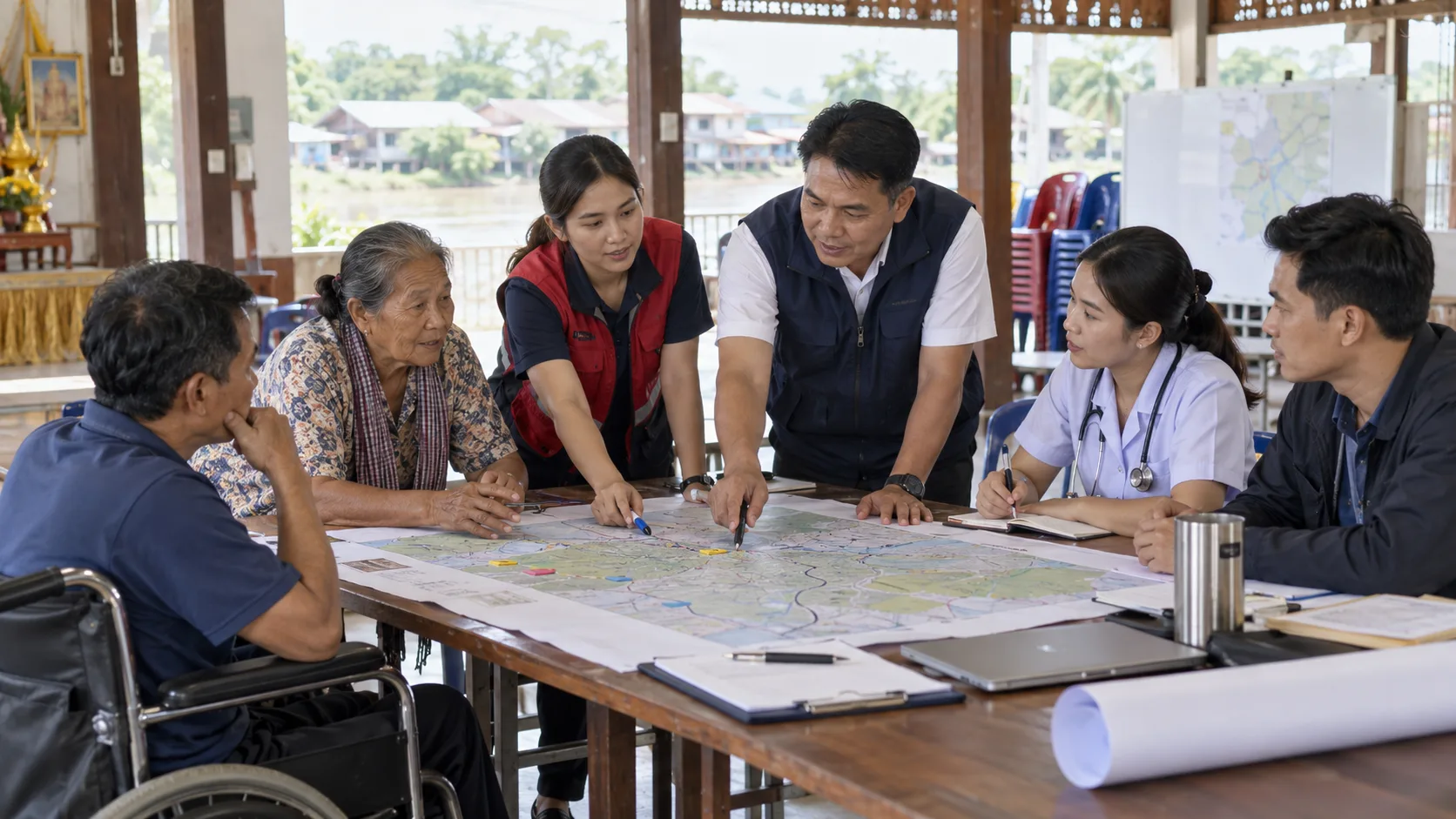
Original exercise: use the 12-group register below as a starting point and add missing groups for the fictional incident. Record impacts, needs, capabilities, decision influence, authority to verify, trust, channels and absent voices. Distinguish evidence from team assumptions.
If using a power–interest matrix, use it only to plan engagement; add need, risk and access barriers. For example, a language-minority household may have no allocation power yet urgent needs and a right to suitable communication; low power is not a reason to put it last.
Add six questions: influence—how can this actor affect decisions/resources; interest—which outcomes matter; legitimacy—what rights, duties or verified representation establish involvement; urgency—what happens if action waits; dependency—whose information/resources are required; barriers—who cannot speak or access services. Justify each answer; do not collapse risk into a single score.
WP01–02: from warnings to verifiable needs
UNDRR's warning-system definition connects risk knowledge, monitoring, communication and response preparedness; the CEA guide supports hearing needs and context before designing assistance.
W1/N1 exercise: a fictional 08:00 notice says route EX-B awaits inspection. Do not turn that into ‘safe’ or ‘evacuate immediately’ without evidence. Draft knowns/unknowns, ask a different-language recipient role to explain back, and record unreached groups and follow-up owners.
Shelter EX-A reports a need for 60 household kits and EX-B for 40. Kits are not people. Ask what each kit covers, who has not been assessed and whether a new report overlaps an old one. Record time, provenance and unanswered allocation questions.
WP03–04: turn information into owned SAR/health requests
Use the DDPM information/follow-up frame to design C1 without reproducing an official form: situation, needs, resources, uncertainty, decisions and open tasks. Keep potentially harmful detail separate from public messages.
At 08:15 an inject reports 55 kits for EX-B while the table holds 40. Preserve both timed reports and ask whether 55 replaces or adds to 40. Do not total 95 or select a convenient figure without checking. The data owner marks it unverified and assigns verification.
One fictional health-referral request arrives without clinical details. R1 records a receiving pathway to verify and task status. Learners neither diagnose nor triage nor send volunteers into hazards. An unanswered referral remains open even after a message was sent.
WP05–06: connect services, resources and actual recipients
Project proposal: involve service users in S1 checks because delivery to a warehouse does not establish access to suitable water, food or shelter. Compare mobility, language, privacy and usable-food constraints. Specialists must verify real technical requirements; this lesson invents no standard ratios.
EX-W starts with 80 kits and no dispatches. Initially verified need is 100, a stock shortfall of 20. But reserving 40 without dispatch does not make undelivered need identical to stock shortfall. L1 separates available, reserved, dispatched and received states.
Propose at least two options, naming early recipients, waiting groups, route conditions, specific needs, simulated approver and review point. Ease of transport does not represent all need. Destination confirmation of quantity and units is needed to record receipt.
Fictional conflict: a funder wants every kit sent to EX-A because photographs are easier, while EX-B has an access complaint. Separate donor preference from need, check whether the condition is acceptable, and propose partial delivery with a B access plan or unconditional resources. Refer to the simulated approver and record who waits; do not expose the complainant to win the argument.
WP07: volunteer tasks and safe feedback
CEA pp.107–109 connect feedback design with diverse groups, action on feedback and referrals beyond an organization's scope, separating sensitive from ordinary information.
At 08:25 a shelter-user role reports an inaccessible distribution point and a sensitive complaint with no disclosed details. Listen without soliciting personal details in the plenary. F1 records only status and owner, verifies the simulated referral route and explains follow-up without promising outcomes beyond authority.
V1 records task, capability to verify, supervisor, help channel, stop boundary and read-back. Large volunteer numbers do not prove hazardous-task capability. The observer records when the team hears challenge, changes work and responds.
WP08: coordinate assistance and recovery handover
SASOP V4 paragraphs 21–23 distinguish affected-party requests, assistance offers and AHA Centre facilitation, including consent for ASEAN ERAT. An offer therefore does not itself authorize deployment.
At 08:35 an inject offers 30 more kits from an international counterpart, without acceptance or arrival time. I1 records ‘offer/pending review’; exclude it from available stock. Prepare gaps and conditions for the simulated national-channel role; contact no real agency.
Sendai supplies a preparedness and risk-reducing recovery frame. H1 therefore hands over unfinished service, livelihood and learning-continuity work with an owner, review date and affected-person confirmation. Ending a CPX does not demonstrate community recovery.
From stakeholder needs to proposed PLOs and CLOs
AUN-QA V4 requirements 1.1–1.5, 2.2–2.4 and 4.5 connect outcomes, stakeholder needs, curriculum design and assessment evidence. Use this as an alignment frame, not endorsement of this lesson or programme.
PLO-P1–PLO-P6 below are an authorized draft, not university-approved PLOs. Proposed cycle: appropriately consult affected people, agencies, learners and graduate users → translate needs into capabilities → programme-owner PLO review → CLO/activity/evidence design → pilot and revise. No consultation is claimed to have already occurred.
STK-K/S/E/C are lesson CLOs. The mapping shows which artifacts contribute to which PLOs; it does not establish programme-wide attainment. Programme conclusions require a planned body of evidence across courses and occasions, calibrated assessors and decisions by responsible programme owners.
Use Bloom's two dimensions with actual tasks
Krathwohl (2002) describes separate cognitive-process and knowledge dimensions: Remember, Understand, Apply, Analyze, Evaluate, Create; and factual, conceptual, procedural, metacognitive knowledge. The CLO table below classifies original project tasks rather than reproducing the article's examples.
Proposed scaffold: check recall and explanation of role/authority distinctions → apply recording procedures and analyze conflicting counts → evaluate two options against criteria → design a handoff plan after conditions change → revisit one's assumptions. Create requires integrating constraints into a reasoned new plan; filling template fields is insufficient.
The five-item quiz samples understanding and application; it cannot fully assess Create. E combines reasoning with protection behaviour; C uses observed listening, correction and handover in the exercise. Cognitive Bloom is not an affective-domain taxonomy, and one score establishes no lasting character trait.
120-minute CPX: conditions, injects and artifacts
Original project exercise; 120 classroom minutes are not response standards: 0–15 review/roles, 15–35 mapping/A1, 35–70 inject play using simulated time, 70–90 options/handoff design, 90–105 presentation/read-back, 105–120 reflection and quiz.
Four to six roles: liaison, information lead, community representative, service/logistics recipient, simulated approver and observer. Disclose combined-role limitations. Paper and digital artifacts are equivalent. Use no real personal data or real agency requests; pause and remove any real data introduced.
Controller clarification: at 08:30, B55 replaces B40 rather than adding to it. Total need becomes 115 and shortfall 35 while available stock remains 80. The 08:35 offer of 30 adds no stock. There is no single allocation answer; all options must check quantities, waiting groups, authority and route conditions. Handover is at 09:00; invent no deliveries.
Assess artifacts, behaviour and evidence limits
Project assessment proposal: rate K/S/E/C separately with artifact codes, times and observations. ‘Proficient’ means evidence in this exercise only, not operational certification. When there was no observation opportunity, record ‘not yet evidenced’ and arrange another, rather than infer poor character.
Before use, two assessors discuss the same sample, record disagreement and refine descriptors. Let learners identify missed evidence and revise. Changes to criteria after seeing work must be transparent and affected ratings revisited. The rubric is not claimed to be validated.
Each learner explains their own decisions and reasoning even with a team submission. Solo learners may complete two role-switched rounds, disclosing the lack of another person's reception evidence or peer observation. End with one improvement, an owner, verification method and retest date.
From stakeholders to tasks and learning evidence
Educational proposal for public review: approved PLOs for this proposed programme have not yet been defined. These are proposed PLOs and lesson-design mappings, not programme-attainment evidence or an official authority chart.
Follow each task to identify whose voice matters, whose authority needs verification, what must be handed over and what evidence learners must produce.
- Needs & rights
- Tasks & stakeholders
- Decisions & handoffs
- CLO · KSEC · Bloom
- Artifacts & rubric
- Proposed PLO & review
Recall/understand prerequisite terms and principles → apply/analyze task data → evaluate options and design a new CPX plan → reflect and retest. Check prior knowledge at each stage; a verb alone does not establish cognitive demand. E/C need additional behaviour observations.
12 stakeholder groups
ST01 · Affected people, households and displaced people
- Operational role
- Rights-holders, local knowledge holders and participants in decisions affecting their lives.
- Needs & rights
- Understandable information, safety, usable services and feedback that receives a response.
- Risks & conflicts
- Reduced to totals without consultation, repeatedly surveyed or exposed through disclosure.
- Engagement
- Use multiple channels, ask what matters, explain constraints and close the loop; low power never means low priority.
Actionable warning communicationNeeds and access-gap assessmentSAR–medical coordination and referralConnect shelter, WASH and foodLogistics from request to receiptVolunteers, protection and complaintsASEAN coordination and recovery handover
ST02 · Groups facing specific barriers and accessible representatives
- Operational role
- Children, older people, people with disabilities, language minorities and excluded groups have different experiences; no representative speaks for everyone.
- Needs & rights
- Safe participation, interpretation, accessible formats, specific support and privacy.
- Risks & conflicts
- Stereotyping vulnerability, treating one leader as universal spokesperson or causing harm through disclosure.
- Engagement
- Identify absent voices, use suitable channels and let people confirm their own needs.
Actionable warning communicationNeeds and access-gap assessmentSAR–medical coordination and referralConnect shelter, WASH and foodLogistics from request to receiptVolunteers, protection and complaintsASEAN coordination and recovery handover
ST03 · Community networks, local leaders and community organizations
- Operational role
- Connect local knowledge, capabilities and feedback; exercise roles require checking legitimacy with communities.
- Needs & rights
- Clear scope, checked information and reporting that avoids unnecessary burden.
- Risks & conflicts
- Influential voices suppress subgroups or recipient lists enable discrimination.
- Engagement
- Invite multiple networks, record dissent and check conclusions with absent groups.
Actionable warning communicationNeeds and access-gap assessmentVolunteers, protection and complaintsASEAN coordination and recovery handover
ST04 · Territorial mechanisms: province, district, locality and Bangkok as applicable
- Operational role
- The DDPM plan distinguishes territorial mechanisms and Bangkok arrangements; check jurisdiction and applicable orders before assigning decision ownership.
- Needs & rights
- Decision-relevant information, resource gaps and tasks with named recipients.
- Risks & conflicts
- Treating a national diagram as incident-specific authority without verification.
- Engagement
- Maintain an authority register with reviewer/status; use simulated roles pending actual verification.
Actionable warning communicationNeeds and access-gap assessmentCommon operating picture and authority checksSAR–medical coordination and referralConnect shelter, WASH and foodLogistics from request to receiptASEAN coordination and recovery handover
ST05 · Central mechanisms and DDPM coordination counterparts
- Operational role
- Use the plan's institutional frame to connect information and support; do not assume one agency approves every task.
- Needs & rights
- Impacts, cross-area needs, resource status and issues requiring escalation.
- Risks & conflicts
- Escalating everything centrally causes delay, or local coordination is bypassed.
- Engagement
- Escalate defined decisions with options and local actions taken; verify channels and mandate before real transmission.
Common operating picture and authority checksLogistics from request to receiptASEAN coordination and recovery handover
ST06 · SAR, engineering and safety services
- Operational role
- Specialist capability counterparts; task acceptance and safety assessment belong to responsible personnel to be verified.
- Needs & rights
- Clear locations, access constraints, reported hazards and a task-reception contact.
- Risks & conflicts
- Liaisons overstep authority, or acknowledgement is mistaken for completed rescue.
- Engagement
- Use timed requests with unknowns, recipient read-back and limits; this lesson teaches no rescue techniques.
SAR–medical coordination and referralLogistics from request to receipt
ST07 · Health, emergency medical and psychosocial services
- Operational role
- Receive coordination referrals and indicate simulated reception readiness; learners do not diagnose.
- Needs & rights
- Necessary referral information, secure channels and destination capabilities.
- Risks & conflicts
- Health disclosure, referral without a receiver or overlooked psychosocial needs.
- Engagement
- Separate sensitive data from the COP; liaise with responsible services and track acknowledgement without personal details.
SAR–medical coordination and referralConnect shelter, WASH and foodVolunteers, protection and complaints
ST08 · Shelter, water, sanitation and food service providers
- Operational role
- Partners checking whether services function for different groups; this grouping is an educational design.
- Needs & rights
- Clear counts/units, site constraints, specific needs and user confirmation.
- Risks & conflicts
- Items delivered but services inaccessible, or gaps between providers remain unowned.
- Engagement
- Jointly review gaps with users, assign cross-service owners and seek specialist technical checks.
Needs and access-gap assessmentConnect shelter, WASH and foodLogistics from request to receipt
ST09 · Volunteers, civil society and Red Cross/Red Crescent networks
- Operational role
- Support access and listening within capability and assignment; never assume every volunteer can perform every task.
- Needs & rights
- Suitable tasks, safety, rest, help channels and information boundaries.
- Risks & conflicts
- Unsafe assignments without capability checks, fatigue or sensitive concerns without referral.
- Engagement
- Brief and read back tasks, verify capability with the responsible role and provide stop/referral channels.
Needs and access-gap assessmentConnect shelter, WASH and foodVolunteers, protection and complaints
ST10 · Private sector, utilities, transporters and funders
- Operational role
- Offer resources, service continuity and constraints; offers are distinct from acceptance or authorization.
- Needs & rights
- Requests with specifications/quantities, receiving arrangements, cost conditions and suitability reviewer.
- Risks & conflicts
- Unsuitable donations, maintenance burden, exclusionary conditions or dispatch/receipt mismatch.
- Engagement
- Disclose conditions/conflicts, check needs with users and record acceptance.
Connect shelter, WASH and foodLogistics from request to receiptASEAN coordination and recovery handover
ST11 · Media, data specialists, universities and learning designers
- Operational role
- Help verify provenance, communicate knowns/unknowns and review learning evidence; cannot endorse incidents or programmes on behalf of authorities.
- Needs & rights
- Traceable data, publication permissions, limits and clear learning outcomes.
- Risks & conflicts
- Rumours, sensitive disclosure or claims that a quiz certifies operational readiness.
- Engagement
- Use message review, disclose limits, separate exercise from reality and gather learner/programme-user feedback.
Actionable warning communicationCommon operating picture and authority checksASEAN coordination and recovery handover
ST12 · ASEAN, international and civil–military counterparts
- Operational role
- SASOP distinguishes affected/receiving parties, assisting entities and AHA Centre; support depends on requests, consent and relevant conditions.
- Needs & rights
- Clear gaps, suitable capabilities, reception points and authorized coordination channels.
- Risks & conflicts
- Treating an offer as consent, unverified tasking or bypassing receiving-state leadership.
- Engagement
- Track request/offer/acceptance separately; check national channels and conditions before using assets.
Common operating picture and authority checksLogistics from request to receiptASEAN coordination and recovery handover
HADR tasks with traceable handoffs
These proposed learning tasks require verification against local plans, orders and actual authority before assigning responsibility.
WP01 · Actionable warning communication
- Task
- Check warning provenance, time, area and uncertainty; test communication with different language and offline recipients.
- Decision & authority check
- Propose channels and comprehension checks; the actual responsible authority must verify the message and release authority.
- Handoff
- Analyst → message reviewer → community liaison; recipients explain back and return gaps to the analyst.
- Verifiable artifact
- W1 message draft with provenance/time/limits/reviewer and recipient response record.
- Review indicator
- Lists unreached groups and follow-up owners; distinguishes sent from understood.
Affected people, households and displaced peopleGroups facing specific barriers and accessible representativesCommunity networks, local leaders and community organizationsTerritorial mechanisms: province, district, locality and Bangkok as applicableMedia, data specialists, universities and learning designers
D01 · Forecasting and early warningD02 · Water, climate and environmentD20 · Risk communication, media and trust
WP02 · Needs and access-gap assessment
- Task
- Hear needs and capacities from multiple groups; distinguish households/people/items, avoid duplicates and mark unknowns.
- Decision & authority check
- Propose urgency based on consequences and barriers, explaining which groups still wait.
- Handoff
- Community representatives → assessment team → simulated decision owner → task recipient, with response to communities.
- Verifiable artifact
- N1 needs table with provenance, time, units, conflicts and unheard groups.
- Review indicator
- Every proposal links evidence and potentially excluded people; uncertain counts remain unverified.
Affected people, households and displaced peopleGroups facing specific barriers and accessible representativesCommunity networks, local leaders and community organizationsTerritorial mechanisms: province, district, locality and Bangkok as applicableShelter, water, sanitation and food service providersVolunteers, civil society and Red Cross/Red Crescent networks
D12 · Community organization and resilienceD13 · Protection and inclusionD03 · Data, GIS and communication systems
WP03 · Common operating picture and authority checks
- Task
- Maintain versioned information; separate facts, proposals, decisions and open tasks; check applicable plans/orders/delegation.
- Decision & authority check
- Identify proposer, decision owner, task recipient and release reviewer; refer unknown authority for verification.
- Handoff
- Data owner → EOC liaison → decision owner with verified authority → recipient read-back.
- Verifiable artifact
- C1 COP and A1 authority register with basis/scope/reviewer/status, plus D1 decision log.
- Review indicator
- Every decision has a decision owner and follow-up; an EOC label never substitutes for an unchecked mandate.
Territorial mechanisms: province, district, locality and Bangkok as applicableCentral mechanisms and DDPM coordination counterpartsMedia, data specialists, universities and learning designersASEAN, international and civil–military counterparts
D03 · Data, GIS and communication systemsD14 · Governance, law and public policyD15 · Crisis leadership and decision-making
WP04 · SAR–medical coordination and referral
- Task
- Record fictional locations, access constraints, capabilities and referral requests for specialist assessment.
- Decision & authority check
- The receiving unit checks safety, capability and reception readiness; learners do not diagnose or authorize rescue operations.
- Handoff
- Reporter → liaison → responsible rescue/health service → destination acknowledges task.
- Verifiable artifact
- R1 request and acceptance/decline rationale, referral pathway to verify and open tasks.
- Review indicator
- Separates request acknowledgement from completed assistance; follows unowned tasks without public health details.
Affected people, households and displaced peopleGroups facing specific barriers and accessible representativesTerritorial mechanisms: province, district, locality and Bangkok as applicableSAR, engineering and safety servicesHealth, emergency medical and psychosocial services
D04 · SAR, engineering and infrastructureD05 · Disaster medicine and public healthD06 · Mental health and psychosocial support
WP05 · Connect shelter, WASH and food
- Task
- Check service access with residents, site managers and specialists; distinguish supplied items from usable services.
- Decision & authority check
- Propose which access gaps to address first and identify the technical suitability reviewer.
- Handoff
- Residents → shelter liaison → water/food/site task owner → verify with residents.
- Verifiable artifact
- S1 service table with needs, barriers, owner and user verification.
- Review indicator
- Includes access checks for limited mobility and dietary constraints; asserts no unverified technical ratios.
Affected people, households and displaced peopleGroups facing specific barriers and accessible representativesTerritorial mechanisms: province, district, locality and Bangkok as applicableHealth, emergency medical and psychosocial servicesShelter, water, sanitation and food service providersVolunteers, civil society and Red Cross/Red Crescent networksPrivate sector, utilities, transporters and funders
D07 · Water, sanitation and hygieneD08 · Food, nutrition and agricultureD09 · Temporary shelters and housing
WP06 · Logistics from request to receipt
- Task
- Reconcile requested, available, reserved, dispatched, received and shortfall quantities with route constraints and recipients.
- Decision & authority check
- Compare feasible allocations, obtain responsible review/approval and record replanning triggers.
- Handoff
- Needs team → warehouse/transport → simulated approver → destination confirms receipt.
- Verifiable artifact
- L1 item/unit/quantity/status/time/recipient tracker with shortfall and fallback plan.
- Review indicator
- Balances quantities, never infers receipt from dispatch alone, and names waiting groups under each option.
Affected people, households and displaced peopleGroups facing specific barriers and accessible representativesTerritorial mechanisms: province, district, locality and Bangkok as applicableCentral mechanisms and DDPM coordination counterpartsSAR, engineering and safety servicesShelter, water, sanitation and food service providersPrivate sector, utilities, transporters and fundersASEAN, international and civil–military counterparts
D10 · Transport, logistics and relief suppliesD17 · Industrial resilience and business continuityD18 · Economy, finance, livelihoods and recovery
WP07 · Volunteers, protection and complaints
- Task
- Match tasks to capability, brief boundaries/help channels and route sensitive complaints through restricted channels.
- Decision & authority check
- Stop tasks beyond capability, refer sensitive concerns to responsible specialists and safely respond to the reporter.
- Handoff
- Volunteer coordinator ↔ volunteer; feedback handler → protection specialist → acknowledgement and follow-up.
- Verifiable artifact
- V1 assignment/read-back and F1 non-identifying complaint-status record.
- Review indicator
- Does not distribute sensitive details in the name of transparency; risky/open tasks have a verified responsible role.
Affected people, households and displaced peopleGroups facing specific barriers and accessible representativesCommunity networks, local leaders and community organizationsHealth, emergency medical and psychosocial servicesVolunteers, civil society and Red Cross/Red Crescent networks
D11 · Volunteers and civil societyD13 · Protection and inclusionD12 · Community organization and resilienceD06 · Mental health and psychosocial support
WP08 · ASEAN coordination and recovery handover
- Task
- Prepare gaps, requested capabilities, reception conditions and service/livelihood/learning handover.
- Decision & authority check
- Separate offer, acceptance and deployment; authorized channels verify consent and conditions first.
- Handoff
- Local liaison → verified national channel → applicable ASEAN mechanism; recovery owner acknowledges handover.
- Verifiable artifact
- I1 request/offer/acceptance status and H1 open tasks/owners/review dates/constraints.
- Review indicator
- No mobilization on an unaccepted offer; recovery work has an owner and is not closed merely because the exercise ends.
Affected people, households and displaced peopleGroups facing specific barriers and accessible representativesCommunity networks, local leaders and community organizationsTerritorial mechanisms: province, district, locality and Bangkok as applicableCentral mechanisms and DDPM coordination counterpartsPrivate sector, utilities, transporters and fundersMedia, data specialists, universities and learning designersASEAN, international and civil–military counterparts
D16 · International and civil–military cooperationD18 · Economy, finance, livelihoods and recoveryD19 · Education and learning continuityD14 · Governance, law and public policy
CLO → Bloom → evidence → proposed PLO
These PLOs are curriculum-design proposals, not RSU-approved outcomes. This lesson provides partial evidence; programme attainment requires assessment across courses and contexts. A team score does not establish individual attainment.
STK-K · Analyze relationships among at least 12 stakeholder groups, distinguishing rights, roles, authority and dependencies with sources and unresolved checks.
- Cognitive process
- Understand → Analyze: explain and distinguish rights, roles, authority and handoff relationships in the fictional incident.
- Knowledge dimension
- Factual and conceptual: role provenance and stakeholder relationships.
- Evidence
- A1 authority table and stakeholder map with unknowns and reasons for links.
- Assessment
- Review map and oral explanation with rubric K; quiz 1/3 support understanding, not full-system analysis.
STK-S · Design and revise an eight-package CPX coordination plan preserving provenance, quantities, units, status, recipients and handoffs.
- Cognitive process
- Apply and Analyze → Create: use tracking procedures, analyze conflicting data, then design a coherent handoff plan under new constraints.
- Knowledge dimension
- Procedural and conceptual: verification methods and resource–service–recipient relationships.
- Evidence
- Two versions of N1/C1/L1 and eight work packages with acknowledgements; explain changes after injects.
- Assessment
- Judge product and design rationale with rubric S; copying a template alone is not Create evidence.
STK-E · Evaluate at least two options against rights, need, risk and access, with a safe feedback route.
- Cognitive process
- Evaluate: compare options using declared rights, need and risk criteria.
- Knowledge dimension
- Conceptual and procedural: protection principles and option-appraisal methods.
- Evidence
- D1 compares two options, recipients/waiting groups and consequences; F1 provides a safe feedback route.
- Assessment
- Rubric E checks reasoning and listening/protection behaviour separately; Bloom describes cognition, not the entirety of ethics.
STK-C · Demonstrate listening to challenge, correction and ownership of open work; analyze reasoning limits and propose an improvement test.
- Cognitive process
- Evaluate one's reasoning and create an improvement plan: use evidence to identify a flawed assumption and design a retest.
- Knowledge dimension
- Metacognitive and procedural: awareness of reasoning limits and methods to improve practice.
- Evidence
- Two-stage observations, H1 read-back and an improvement with owner/retest date.
- Assessment
- Rubric C combines observed behaviour and reflection; no lasting-character or programme-attainment inference from one session.
Source frameworks; task mappings are project proposals: AUN-QA 4.0 · Krathwohl (2002)
- PLO-P1
- Analyze HADR risks, context, institutions and authority boundaries using traceable evidence.
- PLO-P2
- Assess needs and communicate decision-relevant information while protecting data and showing uncertainty.
- PLO-P3
- Design and coordinate multisector support plans with resources, handoffs and accountability.
- PLO-P4
- Evaluate options against rights, need, safety and affected people's participation.
- PLO-P5
- Work in teams, communicate across roles, hear challenge and remain accountable for handovers.
- PLO-P6
- Use exercise and review evidence to improve preparedness and ongoing learning.
The quiz checks understanding and initial application. Analysis, evaluation and plan creation require CPX artifacts, rationale and individual review. Ethics and character require additional behavioral observation.
Use this lesson to prepare exercise context and supporting evidence. It does not add scores or change the existing eight team-assessment criteria.
See the process at a glance
A synthesized learning diagram. Read it alongside the lesson and original sources.
1 · Understand problems and rights
Review prerequisites, identify unheard groups and distinguish sourced facts from exercise data.
2 · Analyze roles and dependencies
Map 12 groups and A1; examine authority, influence, legitimacy, urgency and handoffs.
3 · Apply eight work packages and verify data
Play injects, update N1/C1/L1 and preserve revisions, task recipients and uncertainty.
4 · Evaluate options and design a plan
Compare two options, explain waiting groups, design a handoff plan for new constraints and obtain read-back.
5 · Reflect and collect individual evidence
Use separate K/S/E/C rubric judgements, review with the quiz and set an improvement owner/retest date.
Explore a decision
Fictional scenario: a funder wants all kits sent to an easy-to-photograph site, while another reports access barriers and the liaison has not verified approval authority. What comes next?
The second option respects rights and makes decisions traceable. Resource influence is neither an authority basis nor a measure of need. The exercise prescribes no single allocation; it requires evidence, ownership and a way to communicate constraints.
From knowledge to evidence
Original 120-minute CPX using the lesson injects: submit the 12-group map, A1, W1/N1/C1/R1/S1/L1/V1/F1/I1/H1 and D1 comparing two options, showing all 8 work packages. Each learner identifies their contribution, writes one page of post-inject revision rationale and orally explains one handoff. Observe two stages using the rubric; use proficient/developing/not-yet-evidenced judgements without turning them into PLO certification. Mark everything exercise-only; contact no real agencies.
See CLO–Bloom–PLO alignment and specific criteria for each outcome
| Criterion | Proficient | Developing |
|---|---|---|
| K · Analyze stakeholders and authority | Covers 12 groups and absent voices, explains at least 2 dependencies, distinguishes role/authority with sources and pending checks; each learner can justify the map. | Only lists names or ranks by power, invents authority or cannot explain relationships. |
| S · Eight-package plan and traceable information | Connects all 8 packages with recipient/check/handoff, revises B40→55 without duplication, derives 115 need/35 shortfall with 80 available, excludes the 30 offer and explains the redesigned plan and individual contribution. | Missing handoffs, double counts, treats an offer as stock or merely fills a template without explaining revision. |
| E · Rights, need and safe listening | Compares 2 options against explicit criteria, identifies waiting groups/access gaps, does not substitute donor convenience for need, provides feedback and limits sensitive details. | Claims fairness without consequence comparison, excludes low-power groups or exposes sensitive concerns in public discussion. |
| C · Listen, correct, hand over and learn | Timed behaviour in at least 2 stages: hears challenge/corrects counts and completes recipient read-back at handover; each learner identifies a flawed assumption and 1 improvement with owner/retest date. | Only self-claims/quiz scores, hides corrections, leaves open tasks unowned or lacks retest; absent observation opportunity is recorded as not yet evidenced. |
A proposed rubric for educators to adapt, not a university accreditation standard.
Check your understanding
Answer all 5 questions, then review the explanations. This score is for self-study.
References & further verification
- แผนการป้องกันและบรรเทาสาธารณภัยแห่งชาติ พ.ศ. 2564–2570 ↗กรมป้องกันและบรรเทาสาธารณภัย (DDPM) · พ.ศ. 2564–2570 (2021–2027)
Printed p. 43, Figure 3-2 (PDF p. 54); printed p. 124, incident-management support, items 5.1–5.5 (PDF p. 135); official catalog dpm-gd007 - SASOP: Standard Operating Procedure for Regional Standby Arrangements and Coordination of Joint Disaster Relief and Emergency Response Operations ↗ASEAN / AHA Centre · Version 4.0, May 2025
III–V; V.A paras 21–23, V.B paras 24–27; mobilisation and JOCCA; record of changes p. iii - Sendai Framework for Disaster Risk Reduction 2015–2030 ↗United Nations / UNDRR · 2015; adopted 18 March 2015
Overview: four priorities for action; full framework paragraphs 23–34 - Core Humanitarian Standard ↗CHS Alliance / Groupe URD / Sphere · 2024
Publisher overview of commitments - A Red Cross Red Crescent Guide to Community Engagement and Accountability, second edition ↗IFRC / ICRC · 2021 copyright; second edition, file hosted May 2022
Printed p. 7 edition note; pp. 82, 84 (assessment); p. 103 and pp. 107–111 (feedback mechanisms); PDF pages are printed pages +2 - Sendai Framework Terminology: Early warning system ↗UNDRR · 2017
Definition and annotations: four interrelated elements, official communication, coordination and feedback - Guide to AUN-QA Assessment at Programme Level, Version 4.0 ↗ASEAN University Network · October 2020
Sections 2.1–2.4, printed pp. 16–27: outcomes, curriculum, teaching and assessment - A Revision of Bloom’s Taxonomy: An Overview ↗David R. Krathwohl, Theory Into Practice 41(4); original article hosted by Middle East Technical University · 2002; pp. 212–218; DOI 10.1207/s15430421tip4104_2
Printed pp. 214–215 (PDF pp. 4–5): knowledge/cognitive-process dimensions, Tables 2–3 and taxonomy-table discussion; printed p. 218 conclusion
Cite this module
PK-Research. (2026). HADR stakeholder analysis: rights, roles, work packages and CLO–PLO evidence (stakeholder-analysis, v1.0.0). HADR–CPX Knowledge Commons. https://hadr-cpx.pk-research.work/en/modules/stakeholder-analysis/
Research for further inquiry
Topic-related briefs for critical reading, not validation of every claim in the lesson.
- Institutional capacity, organizational performance and multi-stakeholder collaboration in local disaster risk reduction: evidence from West Sumatra, Indonesia (2026)
- Inter-agency collaboration in building urban fire resilience in Indonesia: how do metropolitan cities address it? (2025)
- Identifying Operational Management Practices in Temporary Evacuation Centres (PPS) for Flood Victims in Malaysia (2025)
- Assessing Thai Hospitals’ Evacuation Preparedness Using the Flexible Surge Capacity Concept and Its Collaborative Tool (2023)
- Study on Process of Building Adaptive Capacity to Climate Change through Social Capital in Low-Income Communities: A Case Study of Nakhon Sawan Municipality in Thailand (2016)
- Disaster governance and the scalar politics of incomplete decentralization: Fragmented and contested responses to the 2011 floods in Central Thailand (2016)
Design longitudinal team CPX assessment
Read how to observe evidence and calibrate scoring
Calibrate and recheck scoring with fresh cases
Apply the lesson in a proposed, unvalidated team pilot plan
Record baseline, post and 6/12-month evidence using independent rater forms